Sunday, 13 July 2014

Day 72. Saumur to Rochefort-sur-Loire.

Day 72. Saumur to Rochefort-sur-Loire. 71km, 4h30.

Breakfast was a delightful French version of Fawlty Towers, so we set off late after homemade plum tarts and advice from our host, Serge. We wound our way back to the Loire past paddocks of horses as the National Equestrian Centre is nearby, and then followed the left bank through small villages of houses built against the cliffs. 

We crossed the Loire at St Mathurin-sur-Loire and  cycled through fields of flowers cultivated for their seed. It was a route full of twists and turns, varied surfaces, with short distances between villages. We bypassed Angers, crossed the Maine River where it joins the Loire and then headed up into the hills above Savennieres. Near la Dagueniere we clocked 4000 km for the trip.

The Loire has become progressively bigger since we first reached its banks. It is the longest river in France and drains more than a fifth of the surface area of France. The Allier, Cher, Vienne, Indre, Maine and many other rivers all add their contribution. The Loire is a gentle river, often dividing around islands, and as the surrounding land is relatively flat, it drains an enormously productive farming area.

We had an appointment to visit Coulée de Serrant at Château de la Roche aux Moines, the wine cellar of Nicolas Joly, the pioneer of bio-dynamic wine production in France. Vineyards are sprayed with milk or whey, fertilized by cows and sheep, and foliar feeds with a host of natural teas. Unfortunately the winemaker, Virginie Joly, was not around, so we were given a brief taste of their 3 excellent Chenin Blancs, all 2012. The grapes in this region are grown on slate soils, imparting a high acidity and green apple and honey flavor. 

We then stopped at Domaine Tailandier, where we had been 10 years ago. We received a warm welcome and were given an excellent overview of the wines of Savennieres (dry Chenin Blanc) and Valle du Layon (sweet Chenin) wines by the winemaker's Japanese wife. A very enjoyable tasting of 2 to 10 year old wines. The older wines develop a distinctive honey taste without losing their freshness. The 2004 Sec and 2009 Demi-sec were particularly good. The French drink more sweet or semisweet wines with their food than we do back home, particularly with strong cheeses, fois gras, oily fish and spicy dishes. It makes sense.

We then crossed the Loire to Rochefort to our overnight stop, Molin Geant, an old mill (1500s) and farmhouse on the outskirts of the village. We were given a warm reception by the hostess, Elke, who invited us to cook our own supper in the kitchen, and then laid a table or us and provided wine and dessert. We had spectacular views over the Loire valley from the lookout lounge on the top of the old mill-house where we were accommodated. 

Loire elegance.

Lake on the Loire floodplain.

Villages hugging the bank.

Rolling hills.

A milestone.

Another step further.

Gourmet lunch - baguettes again.

The vineyards at Nicolas Joly overlooking the river.

The colour of the hydrangeas is intense.

Mme Tailandier showed us their range of wines.

The old millhouse - our bedroom for the night.
The view from the top.

Relaxing at the top of the millhouse after a long cycle.

Saturday, 12 July 2014

Day 71. St Michel to Saumur.

Day71: St Michel-sur-Loire to Saumur. 75km, 4:55

There were some Americans from Boulder, Colorado staying at the Chambres de Hote who we had a long chat to over breakfast. We gave them the Rhino talk,
they were fascinated and we found that a lot of what we said was new to them. 

We left a little later than usual as we thought we only had 45 km to go, as you can see it was a little more. It was cloudy and cool, but we soon warmed up as we made our way along the Loire, passed Brehemont, Ile St-Martin and la Croix Rouge where we left the Loire to wind our way inland over the flood plains through Avoine where we found an excellent Boucherie Charcuterie and bought a delicious picnic lunch. We continued to Savigny-en-Veron to the La Vienne river. We passed through beautiful villages and lush countryside, with fields of flowering sunflowers and ripening wheat. There were cattle grazing along the polder that was built to stop flooding at the confluence of the Indre and Loire rivers. The land is very fertile here as a result of the flooding and the rich silt that is deposited on the banks. The sun tried hard all morning to make an appearance. It was only after our lunch stop that it managed to break through the cloud cover to give Gill and Mitch a little bit of a suntan.

We passed Rigney d' Usse where the enchanting fairy tale castle, Chateau d' Usse, with it's many turrets and towers guards the Indre Valley. Legend has it that it is this castle that inspired Charles Perraud when he wrote the famous fairy tale "The Sleeping Beauty".

We followed the route above the Loire through historic towns and vineyards. It was a short steep climb to get onto the limestone ridge next to the vineyards. Most of these villages have limestone caves gouged out of the cliffs. Some of these have been imaginatively converted to shops, art galleries and perfect conditions in which to store wine.

The Chateau de Saumur is known for its beautiful light architecture, built of of the lovely soft local toffee au stone; it makes quite a statement as one enters the town. Saumur is situated between the Loire and Thoute rivers, and is surrounded by vineyards as far as the eye can see. Some excellent wines are produced here including the delicious Cremant de Loire and Cremant de Saumur which is the champagne of the region. 

On our way to L'oiseau Blue, our Chambres de Hote, we passed the large Sparkling Wine house, Bouvet Ladubay, where we tasted the delicious sparkling wines. These are made mostly from Chennin Blanc and a small percentage of Chardonnay. The vintage sparkling wines are aged in oak barrels for a year. Bouvet Ladubay have been making sparkling wine since 1851, and at the turn end of the 19th century were the biggest producer in France. They have 8 km of tunnels behind the winery for storage of their wines.

We enjoyed our Chambres de Hote, L'oiseau Bleu - the rooms were charming and the roses planted in the driveway all mean something to the friendly owner, Serge.

Gilly and Mitch treated us to an excellent gourmet dinner at L' Aromate in the town. This is a superb restaurant run by a husband and wife team. The combination of flavours is so well thought out and work very well to create innovative dishes from the region. We cycled down to the restaurant and had to cycle up a steep hill on the way back but it was worth it as it was an absolutely delicious dinner.

Forests and sunflowers.

A big happy smile.

Through the forests.

We were entertained to a game of pétanque during our lunch stop.

Troglodyte dwellings against the limestone cliffs.

Champigny-Saumur vineyards above the Loire Valley.

Hollyhocks are everywhere.

Tasting bubbly at Bouvet-Ladubay.

The excellent restaurant where we were treated to dinner.

Friday, 11 July 2014

Day 70 - Vouvray to St Michel-sur-Loire.

Day 70. Vouvray to St Michel-sur-Loire. 55km, 3h37.

Where is the French summer? A third of the way through July and it's cloudy and cool, with some light rain forecast. The rest of France has had some terrible storms with severe hail in the Burgundy, Alsace and the South West at different times. The apple and wine farms have suffered severe damage.

We set off along the northern bank of the Loire, passing limestone cliffs with troglodyte houses and wine cellars. We soon reached Tours, our route taking us straight down through the centre to the Cher River on the south side of the city. We stayed on the Cher to Savonnieres where we stopped for the caffeine top-up. Further down the road we came to Villandry, one of the garden highlights of France.

Villandry must be one of the "big five" of European gardens. About 115000 flowers and vegetables are planted out each year. The centerpiece is the vegetable garden, or more correctly, the decorative kitchen garden. It is made up of 9 squares, each with a geometric planting of a total of 40 species of vegetables, interspersed with clipped box hedge, standard roses, arbors, pear trees and espaliered apple trees. This garden is the last remaining monastic garden from the Middle Ages in France, although it does have some classical Italian and the French influence.

In addition there are the ornamental gardens made up of 4 sections each depicting a type of love; the sun garden with the cloud room, the sun room and the children's room; the maze; the serene water garden; the herb garden; and the woods on the hillside. The various gardens are at different levels so allowing for both good views and an element of surprise.

From Villandry we continued along the Cher to its confluence with the Loire and then crossed a beautiful bridge to Langeais. There are quite a few Chambres d'Hote along this section, probably to cope with the large number of tourists and cyclists here. Langeais is an attractive small town with winding streets and is dominated by the Chateau. We then had a 5km ride up to St Michel-sur-Loire where we spent the night at Villa Garnier, with its ornately decorated rooms. We tiptoed around not wanting to bump anything - it was quite a mission to do the washing and pack and unpack panniers. They have a large garden, so we enjoyed our al fresco evening meal of supermarket roast chicken followed by excellent Reblochon cheese, accompanied by the superb 2010 Bernhard Fouquet Le Marigny Sec (a unanimous WWS 9) which Bernhard very kindly gave us in Vouvray.


An old wagon on the banks of the Cher River.

Chateau Villandry.

The decorative kitchen garden.
 

The ornamental garden depicting four types of love.

Time-consuming work,
.
More tourists.

View from the Belvedere. 

The sun garden.

The bridge to Langeais.

Showered and ready for supper.

One of the best wines we've had on our trip.

Thursday, 10 July 2014

Day 69 - Rest day in Vouvray.

Day 69: Rest day in Vouvray.

It was a mild day as we set out to Domaine de Aubusierres our first wine tasting appointment for the day. Bernard Fouquet the delightful winemaker and owner took us through his range of delicious wines including a vertical tasting of the Le Marigny. 

We started with the Cuvée de Silex 2012 made from grapes that grow in clay-silicious soils. This was a dry wine which had good minerality and hints of tropical fruit and dry lemon. 
The vertical tasting of Le Marigny 2013, 2012 and 2010 showed how the wine developed and matured in the bottle which was very interesting. These vines grow in clayish-limestone soils and the wines have good minerality with notes of peach coming through. These wines are showing well but need more time in the bottle. 

Les Girardieres 2012 is a semi-dry wine from clayish-silicious soils with 20% botrytis. It had fruity, floral aromas with a hint of lime. The last two wines were delicious. Cuvée Alexandre 2009 made from 100% botrytis grapes grown in clayish-limestone soils. The sugar is 116grms% and it is absolutely wonderful with notes of truffle,honey,quince and candied fruit. The opulent nose and flavours on the 2003 vintage is quite remarkable. It is made from 100% botrytis grapes and 200grm% sugar and has good acidity, which does not overpower. Bernard has created a wonderful wine that is perfectly balanced, has good structure and remarkable quality.A real pleasure to drink. Bernard's passion and love for winemaking has allowed him to make wines of outstanding quality.

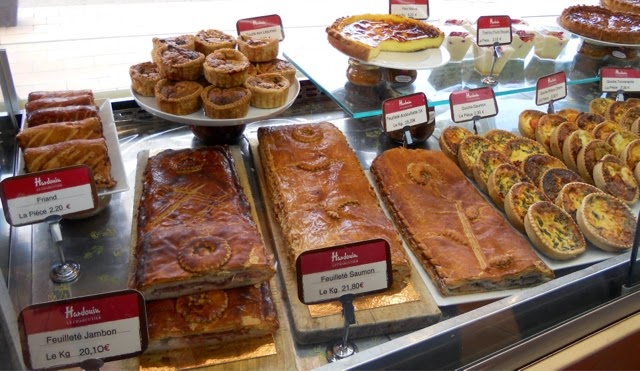
After a cup of coffee and a petite tarte from the local patisserie we headed off to the Charcuterie to pick up some lunch of salmon and jammon pies that we had at our Chambres de Hote. Some delicious food from the Val de Loire.

We had booked an appointment at Domaine Huet for the afternoon, which we were looking forward to as they have been using Biodynamic farming methods for many years. 
Johan Le Calonnec took us through the tasting of 7 wines, which were all good . We started with two Cremant de Loire sparkling wines, the first the Cuvée Brut Petillant with delicious flavours of ripe pear, pineapple and mango with a fine effervescence was very pleasant. We all preferred the Cuvée Brut 2009 which showed more minerality and biscuit flavours.

Their most famous vineyards are the Haut Lieu which are situated on clay soils. The Moelleux 2003 ( sweet) was particularly good from this area. The wonderful thing about these wines is that although the sugar is high it has firm acidity so the wine does not finish sweet.

It was a real treat to taste the 1997 Clos du Bourg Moelleux Premier trie 1997 which was absolutely delicious. We bought a bottle of the Le Mont Demi-Sec 2007 which had better acidity than the 2003 vintage, which was a very hot year. The Demi-Sec goes well with the cheeses from the area, especially mature goat's cheese.

Supper was at a little Pizzeria Creperie, La Terr'a Sandra down the road where they serve delicious pastas too.

What a lovely laid back town and so special to visit the Domaines of two of the best producers in the region. A wonderful day all round.

Our tasting at Domaine de Aubusierres with the winemaker and owner Bernhard Fouquet.

There is a 300 meter tunneled cave where the wines are stored. The tunnels were made 300 years ago to quarry stone to build the chateaus.

The impressive line-up at Domaine de Aubusierres.

Difficult choices for lunch.

In the caves of Domaine Huet. They have over 1 km of tunnels, and the oldest wine stored here is the 1919 Chenin Blanc. 

Inspecting the vineyards above Vouvray.

Wednesday, 9 July 2014

Day 68 - Blois to Vouvray.

Day 68. Blois to Vouvray. 69km, 4h10.

After the high carb French breakfast at the characterful Hôtel De France Et De Guise, we were pleased to cycle in cool still conditions after our drenching yesterday. Small lanes took us through the farming villages of Chailles and Cande-sur-Beuvron, and then back down to Chaumont-sur-Loire, with its chateau high up on the steep hill above the Loire.

We then headed up into the vineyards of the Touraine, which are planted on the flat plateau above the Loire flood plain. We had a steep descent into the attractive, but touristy, town of Amboise. The attractions here are the chateau and the Leonardo da Vinci museum. Da Vinci spent the last few years of his life working in Amboise, which was a favourite royal residence in the late 15th century. King Charles VIII died there after hitting his head on a door lintel!

Then it was back up onto the plateau for a ride through the vineyards of Montlouis, some of which looked really old. We crossed the river via a very long and busy bridge to Vouvray, well-known for its superb Chenin Blancs. We arrived unannounced at Chateau Moncontour, one of the larger producers in the area, where we were given an extensive tasting of their sparkling and still Chenins. We particularly enjoyed the Cuvée Prédilection Grande Réserve 2010 Brut 2010, which had 3 years on the lees, the dry 2010 Les Chapelles (both WWS 7) and an excellent 2003 dessert wine (WWS 8). The delicious effect of Botrytis was evident in the sweet wines.

Our Chambre d'Hote (La Tonelle) is set against the hillside and the lower back wall is a cave.  We are on the top floor up a precipitous spiral staircase, and our large attic room leads onto a small garden. It is a very relaxed place, and as we are staying here for two nights there is space and time to do washing and clean the bikes. The weather moved our picnic supper back indoors. 

Loire countryside showing off.

Finding our way through the villages.

Chaumont-sur-Loire 
The traditional Loire river boats

Chateau at Amboise.


Sunny side up.

Bubbles at Chateau Moncontour.

Tuesday, 8 July 2014

Day 67- Orleans to Blois

Day 67: Orleans to Blois. 68km, 4:08.

We set off in the rain this morning, which was not ideal for Gill and Mitch's first day of cycling. To start it rained lightly but it increased steadily as the day progressed. Fortunately it was not too cold and there wasn't much wind.

We stopped at the gorgeous little town of Meung-sur-Loire where the weekly market was in full swing. We spent some time absorbing the wonderful atmosphere that one encounters at these markets. People chatting about the various items of produce as well as catching up on some news. There were some excellent Brioches, cheeses, pates, fish, cherries and fresh chanterelle mushrooms. We were sorry we did not have self catering accommodation for the night as we would have cooked up a storm with all those delicious ingredients. After a warm cup of coffee, we set off again. 

It was a pity that the weather was so crummy as we passed through some interesting places. When it rains one tends to put one's head down and keep going!

At Beugency we needed some warming up so we stopped for lunch. We could not find a restaurant that served a Plat de Jour on a Sunday and had to settle for a gourmet Black Angus burger which was delicious, warmed us up and gave us the courage to face the elements. We still had 45 km to go and the rain did not let up the whole way.

We arrived at our accommodation in Blois, Hotel de France Et De Guise, looking like drowned rats. Amazingly the rain stopped the minute we pulled in at Blois - Murphy's Law! When we walked in Ian and I realized that we had stayed in the same hotel 10 years ago. After a hot shower we felt refreshed and ready for some sightseeing.

Blois is a delightful city, and it is particularly special to me as my ancestors on my Mum's side, the Bruwers, originally came from here.

The Chateau de Blois is impressive and was built by the Counts de Blois. Joan of Arc visited the Chateau in 1429 to receive a blessing from the Archbishop of Reims before setting off with her army to drive the English from Orleans.

The House of Magic that is closely connected to Robert Houdin, the famous magician,who was born in Blois has a Polychrome facade and large figures of dragons and a dragon's tail that pop out of the windows every hour. It houses a small museum of the history of magic. 

There is a beautiful garden just below the the St Nicholas Church in the old quarter of Blois - the Archbishop's garden. Unfortunately the roses were passed their best, but there was a lovely view of the city and the Loire.

We ended the day having a picnic supper in the park across the road from the hotel, in the warm evening sunshine.

Drying out over coffee in Meung-sur-Loire.

The wet street market in Meung.

The sky (and our spirits) lightened as we reached Blois.


The rooftops and rose garden in Blois.

The Chateau from our picnic spot.

The Museum of Magic. The dragons come out to roar every hour.

Alley way in Blois.

Monday, 7 July 2014

Day 66 - Sully-sur-Loire to Orleans.

Day 66. Sully-sur-Loire to Orleans. 54km, 3h35.

It was cloudy and drizzly when we left the farm where we spent the night. We enjoy these casual places to stay; I could give the bikes a good rinse off after the muddy day yesterday, and they are quite relaxed about heating our food and cooling the wine.

After meandering through farmlands of mostly vegetables, including asparagus, beans, and beet root, we were back on the berm alongside the Loire. The rain became harder, so we stopped in Chateauneuf-sur-Loire to thaw with a cup of hot chocolate. We sat under the awning of a pavement cafe amongst the village conspiracy of bronchitic smokers, all doing their bit to ensure that La France maintains its leading position for the incidence of  lung and throat cancers.

The clouds lifted a bit for the rest of our cycle to Orleans, the route hugging the south bank and overlooking maize farms. There was a market in full swing at the bridge taking us over the Loire to Orleans, so we had excellent ham and goats cheese on our baguettes.

Gilly and Mitch arrived in Orleans from London at 1.30 to join us for a week's cycling. We arrived simultaneously at their bike rental shop - very exciting to see them again, and wonderful that they can join us. After loading their kit onto their bikes (very nice Trek tourers) we had a welcome beer in the Place du Martroi with its massive statue of Joan of Arc. 

Orleans is an appealing city, with broad streets and interesting buildings. The Cathedral St.  Croix dominates the skyline. It was modeled on and is the same size as the Notre Dame in   Paris. The stonework of the buttresses, facades and columns is very intricate. Joan of Arc appears everywhere as she (with a bit of help from her friends) relieved the siege of Orleans from Plantagenets in 1429 during the Hundred Years' War.

We stayed in studio apartments close to city centre (Appart City Orleans) which are very well furnished and equipped. To be able to self-cater is a real plus. And there were decent pillows - I could write a whole blog posting on the various pillows that Europeans seem to like and we have endured on this trip. I could do the same for impossible door handles, taps that require extreme lateral thinking to operate, toilet design that needs serious ergonomic help and the challenge of finding the World Cup game on television (forget about Wimbledon - it was a non-event here). 

Meeting up with Gilly and Mitch at the bike rental.

Joan of Arc also rode through here. I wonder if we'll get a statue too.

The St Crois Cathedral.

Detail of the front fascade.

Half timber houses in the old tradesman quarter.

Polychrome brickwork of the Hotel Groslot opposite the cathedral.