Friday, 23 May 2014

Day 22 - Vremski Britof to Ljubljana.

Day 22. Vremski Britof to Ljubljana. 99 km, 5hrs45.

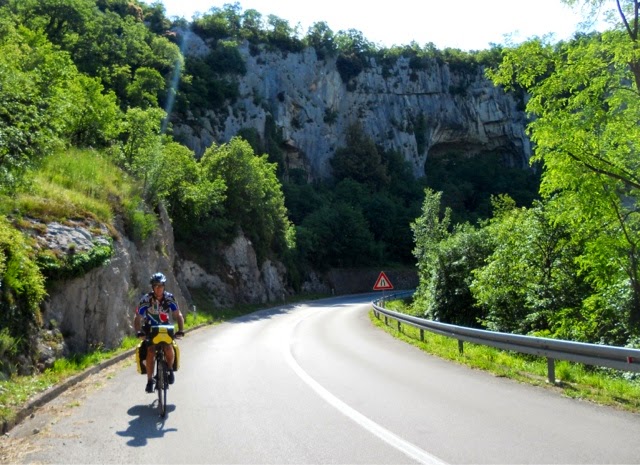
An early start as we planned a long day in the saddle. We climbed over the mountains before dropping into the Sava and Ljubljana river basins. The vegetation has become ever more alpine, with few oak trees and plenty of pines. Roses are in full flower in Croatia but still in bud here. The peonies are magnificent.

The tourist information in Vrhnika (there's a name to get your tongue around) advised us to take a small country road to Ljubljana via Bistra and Borovnica. This is a delightful route through small attractive villages overlooking what was previously a huge marsh, but is now cultivated. It is serious hay fever season here so the Spersallerg drops are flowing like water.

Ljubljana is immediately appealing. The university is close to the centre so there are students on bicycles or sitting in sidewalk cafes everywhere. There are 60000 students at Ljubljana University - there are no fees so most students study for 7 years. The whole of the old city centre is traffic-free, apart from bicycles. The atmosphere is both relaxed and vibrant. No policemen are to be seen. The fact that the main square is named after a poet (Presernov) and not another politician or military commander speaks volumes about the city.

The Ljubljana castle overlooks the city, which is built around the Ljubljana river. The old buildings are impressive with the added touch of the famous architect Joze Plecnik who is to Ljubljana as Gaudi is to Barcelona. The history of Ljubljana is long and eventful; Jason supposedly stopped here for the winter on his way home with the Golden Fleece. On the trade route between the Mediterranean and the Black Sea, it has seen influence from the Slavs, Germanics, Italians, Crusaders, Hapsburg Austrians, Napoleon's army, followed by an eventful Nazi resistance and then the Tito communist era.

We found a restaurant serving Slovenian food, so it was goulash with polenta for supper. We spent our time there chatting to an American couple who were interested in the rhino situation in South Africa. It turned out that the husband, Doug Dvorak, is an international motivational speaker and author.
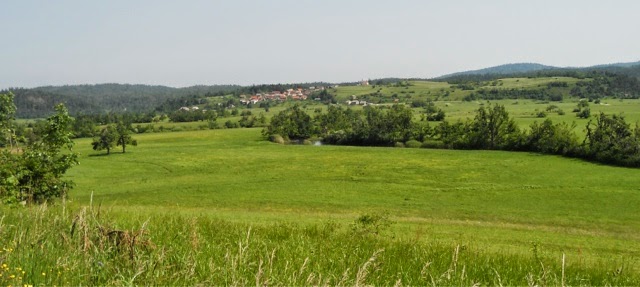
Typical Slovenian countryside.

Anyone can understand Slovenian.

Hayfields on the reclaimed marshlands near Ljubljana.

Our biggest day so far!

So getting our priorities right.

The riverside in Ljubljana.

Ljubljana market - irresistible.

Ljubljana River, old city and castle.

Thursday, 22 May 2014

Day 21 - Lipica stud farm and Skocjan caves.

Day 21: Sightseeing in the Karst area of Slovenia, Lipica and Skocjan Caves. 37 km.

Karst refers to an arid limestone plateau in Slovenia, the Karst region that is near the Italian border.

After a hearty breakfast we left our panniers at the Hotel and set off for Lipica the home of the Lipizzaner horses, a 10km cycle from Divarca.

Lipica Stud Farm was founded in 1580 to provide horses for the Habsburg court in Vienna. The Lipizzaner horse as we know it today, was bred from a number of different breeds including the native Karst horse as well as Andalusian horse blood lines, from the Habsburg Archduke Charles' homeland. The Lipizzaner stallions are known for their noble gait and strong build, and were made famous by Vienna's Spanish Riding School. Today they are are used for their clever routine in dressage competitions and performances.

The foals are born black or brown and change color over time until they are completely white after 8 years. Only stallions are trained and training starts when the colts are 4 years old. It takes 6 years to train a horse to the performance stage.

Unfortunately there was no performance today but we could go to a training session. It was wonderful to watch the skill of both the horse and the rider in perfect harmony. We so enjoyed visiting the Stud Farm which had a lovely tranquil feel and magnificent horses.

We had to go back via Divarca to pick up our bags as we are spending the night in Vremski Britof, 6 km down the road from Divarca, and 4 km from the caves. 

Skocjan caves wind through ever more impressive grottoes until one reaches a huge canyon with a raging underground river, the Reka. The formations are spectacular with stalagmites and stalactites of various ages hanging down and rising up from the limestone rocks. To give an idea of the size of some of the caverns, the first one we visited could fit St Peter's cathedral inside it. We decided to visit Skocjan caves instead of Postojne caves as they are less touristy and include a massive underground canyon with a river rushing through it, something we had not seen before. Unfortunately we could not take photographs, but the caves were really very impressive.

Lipizzaner mares and foals as we arrived.

Mares in the old stable

Young stallions yet to start training.

Limestone cliffs on exiting the Skocjan caves.

Wednesday, 21 May 2014

Day 20 - Motovun to Divaca, Slovenia

Day 20. Motovun to Divaca, Slovenia. 71 km. 4 hours.

We bade an early farewell to the old couple,our hosts for the last 2 nights. They sent us on our way with a bottle of cherry brandy to "help us up the hills". A cold descent was followed by an enjoyable cycle through forests along the Mirna river to the hilltop town of Buzet, and then up to the Slovenian border. We spent our last few kunas drinking coffee in the border town of Strped. While looking forward to exploring Slovenia, we are certainly going to miss characterful Croatia.
The border crossing went smoothly, and then we had a long descent below limestone cliffs accompanied by the songs of cuckoos and hoopoes. We had amazing views all the way to Trieste on the Italian coast.
We eventually found accommodation in a hotel in Divaca, near the Skocjan caves which we plan to visit tomorrow. 

Off to Slovenia. Bog Croatia.

Limestone cliffs into Slovenia.

A climb up to Kubed.

View down to the Adriatic en route.

Tuesday, 20 May 2014

Day 19 - A day in Motovun

Day 19. Exploring Motovun, the wine and truffle capital of Istria

The sun was out as we set off to Fakin Winery 2 km down the road from Motovun. The young innovative winemaker Marko Fakin spent two hours taking us through his various wines. His main varietals are Malvazija and Tenat. We tasted 5 Malvazijas; two were his top unwooded wines, one was a blend that he uses as a house wine in his  restaurant  in Motovun, one was a blend that he sells unbottled to people in the community and the last one was wooded in acacia barrels.
The Malvazija grown in Istria is different to those found in Greece, Italy and Spain and has melon and gooseberries on the nose. 
We then tasted 3 Terans which were all very good. The third one we tasted was still in the tank. He made this wine late in the season; he put the grapes stalks and all into a plastic container, sealed it and then forgot about it. About 5 months later he opened it and it was full of hydrogen sulphide. His father told him to throw it away, but he decided to add a little sulphur and wait. He removed the stems after 8 months and left the skins. After a year he  transferred the wine to old oak barrels for a year before bottling it. As an afterthought he entered the wine into the Istrian wine show and won the medal for best wine on the show. He is very proud of this wine, B&M, which he says he discovered by accident.
Marko, who is only 26, is passionate about his winemaking which he started in 2009 when he moved back to the farm. He spent 2 years in Rijeka studying Economics, but decided that city life was not for him. He is adamant that he wants to conserve the legacy that his forefathers left him through the farm, but is also forward thinking and ready to take risks in order to produce excellent wines. The family have continued to make prsut in the Istrian way using a secret family recipe handed down from generation to generation.
The winery is modest and unpretentious; his wines prove that it is not necessary to have a state of the art operation to produce award winning wines. Fakin Wines is a family concern, while Marko makes and markets the wines, his father and brother do the viticulture.
Marko presented us with a bottle of his B&M Teran and a package of prsut and pancetta for our dinner.
It was refreshing to spend time with this passionate, talented winemaker and we were very privileged to meet him. He was exceptionally generous, and we felt quite humbled by the experience.
We certainly enjoyed our dinner of pasta, prsut and Teran. The wine was the best we have had in Croatia (WWS 9) - what a treat. 
 
Fakin vineyards and winery.

A barrel tasting of Malvazjia with Marko Fakin.

Homemade prsut hanging in the cellar.

Monday, 19 May 2014

Day 18 - Porec to Motovun.

Day 18. Porec to Motovun. 26 km, 2hrs 30.

A short and relatively easy cycle today, although the weather remains cold and cloudy. There are serious storms and floods in Bosnia and Serbia, so we are experiencing the tail end of that weather system. We are still cycling with 3 top layers and leggings. After negotiating all the roadworks deviations out of Porec, we cycled against a stiff wind to Visnjan, where the obligatory coffee and hot chocolate break was called. Then a hilly approach to Motovun through forests and farmland. Motovun is a fortified hilltop village with magnificent views in all directions. Fortunately we found a room to stay halfway up the steep hill to the  ramparts.

Motovun is the culinary centre of Istria. It is surrounded by Istia's best wineries and is now famous for its truffles, ever since a world-record 3 lb white truffle was found in a nearby oak forest in 1999. We were greeted to our accommodation by the yapping of truffle dogs and a glass of Rakija with our host.

We spent the evening exploring the old town. Sunday is a busy day here as Motovun is a popular restaurant destination for day-trippers. While sampling wine, olive oil and truffle pâté at a small shop, we were fortunate to be introduced to Marko Fakin, one of the young guns of Istrian winemaking. He invited us to visit his winery tomorrow, which we are looking forward to as, at a young age, he has gained a considerable reputation for innovative winemaking.

We found a quaint restaurant, Konoba Mondo, at which to spoil ourselves with a tagliatelle with fresh black truffles, a novel experience. 

Approaching Motovun.

Rakija on the terrace on arrival at our sobe.


Where we came from...

And where we are going. The road to Slovenia. 

Sunday, 18 May 2014

Day 17 - Rovinj to Porec

Day 16 - Rovinj to Porec. 45km, 3:30

Our route today took us along the Limski fjord over mixed terrain with quite a climb along the edge of the fjord. The Limski fjord is 20 km north of Rovinj and a popular boat trip from there. The deep inlet is flanked by steep forested terrain. At the top of the climb,there is a view point which gave us a beautiful vista across the fjord. 
Matosevic Winery was not far so we set off for a wine tasting. The heavens opened when we arrived there,w so fortunately we could get some shelter with a wine tasting thrown in. 
Slaven, the assistant winemaker took us through the wines. He is absolutely passionate about his job and gave us an interesting overview of the various wines. All the whites were Malvasjias; the first was the Alba, an un-wooded wine vinified in stainless steel tanks and made to drink early. The other three were wooded and more serious wines. Interestingly they were aged in French oak as well as Istrian acacia barrels which gave the wine a different complexity with which we were not familiar. The red wine we tasted was a Merlot Teran blend; although it was a 2012 vintage the tannins were still quite firm and I suggest one should give it another three years at least. It will last well for 10 - 15 years.
Fortunately it had cleared when we left the winery but it was really cold so we put on our leggings and extra sleeves and set off. 
It is unbelievable that we have been in Croatia for over 2 weeks now and we have had  only 4 days of sunshine. Slaven said that the season had been unusually cold and wet which did not bode well for a good harvest.
A few of the restaurants along the road were doing suckling pig on the spit. We. Could not resist stopping at a lovely roadside restaurant were they had a leg of pork on the spit. It looked absolutely delicious and well-supported by the locals. It was just what we needed and was very reasonably priced too.
From there we wandered along a rural road that wound its way through quaint villages for about 8 km before we joined the 303 that took us into Porec.
Porec is almost 2000 yrs old with the old town set on a peninsula. The most notable attraction is the Euphrasian Basilica that has gorgeous glittering mosaics dating back to the 4 th century. The Basilica was rebuilt 3 times and each time the floor was covered in mosaics. We were caught up in a Croatian wedding that was a very jolly affair.
Porec is quite touristy and didn't have the same charm as Rovinj.  
We found a lovely apartment in suburbia in which to spend the night.

One of many olive oil and schnapps stalls above Limski Fjiord.

We couldn't resist stopping for spit roast pork.

The Euphrasian Basilica in Porec with 6th century mosaics.

Day 16 - Labin to Rovinj

Day 16. Labin to Rovinj. 56 km, 3:30.

We headed off later than usual as we had breakfast included in our accommodation for the night. They opened at 08:00 and it was well worth the wait as we had a hearty breakfast of eggs and ham to see us through to lunch time.
We set off in our winter gear with a long descent out of the town. The road was narrow and quite busy with trucks and buses, but we had no other option to get from Labin to Rovinj but on the 21 motorway.
Soon we descended into a beautiful valley and cycled along the Rasa River through cultivated farmland. What a surprise to see an Osprey preening itself in a tree along the way. 
We had a moderate climb over a pass and then we descended to the turn off to Petehi which took us off the 21 motorway. This was a good idea as we hardly saw another vehicle for 20 km. This route took us through beautiful indigenous forests, along dry stone walls and agricultural lands to the beautiful village of Svetvincenat (try to pronounce that) where we stopped for coffee. It's grandiose Morosini-Grimani citadel with towers from the Renaissance era guards the town square. It is one of the most attractive Venetian villages from this period.
Next we passed through Kanfanar which was developed in the 17th century. A short 20 km along the road we arrived at the charming town of Rovinj which is the most Italian town in the most Italian part of Croatia. A really good day of cycling; touring at its best.
Rovinj is everything we were expecting it to be. Tall ancient houses line twisty streets where one gets lost while exploring.The old city is built on what was once an island and is now a peninsula.The Old Town peninsula is topped by the Church of St Euphemia, patron saint of Rovinj. It is said that the remains of this 4th century martyr were found floating off the coast here in a gigantic marble sarcophagus - believe that if you will. The bell tower has a weather vane in the shape of St Euphemia; the local fisherman decide on whether to go fishing or not depending on which way she is facing. When Euphemia is facing out to sea, it means the stiff, fresh Bora wind is blowing, bringing fair weather. If she is facing land, the humid Jugo will bring bad weather from the sea.

Svetvincenat village on the Istrian plateau.

View from our bedroom window.

Old city of Rovinj - unfortunately no sun.

A local Malvazjia for supper.

Friday, 16 May 2014

Day 15 - Cres to Labin.

Day 15. Cres to Labin. 51km. 4hrs 30.

The morning started with a solid 55 minute climb out of Cres town through olive and pomegranate trees to the top of the spine of the island. The famous Cres white-faced condors were circling. Here we crossed the 45 degree parallel which, if my standard 8 geography serves me correctly, is where the zones change from warm to cool. Sure enough, we were met at the top by the biting Bora headwind, as well as spectacular views over oak forests to Krk island and the mainland. 
We had a long freezing descent to Porozina where we thawed out with hot chocolate while waiting to catch the ferry to Istria. 
Then followed a climb from the ferry port to the coastal road and after a blustery section along the coast, we turned inland for another climb on cobblestones to the old mountain-top village of Labin. We were completely pooped, so fell into the Pizzeria Napoli for a jumbo mexicana and draught Ozujsko.
We enjoyed exploring the old city of Labin with great views towards Cres Island from the ramparts. There are numerous old Romanesque style churches, with Venetian influence ever present. 
Accommodation here should not be judged from the outside. Our room on the old city wall had a really seedy exterior, but inside we found a spotless room with the most comfortable bed and pillows of our trip. (Most of the pillows here are like sacks of mieliemeel). In the small restaurant downstairs we were served a local dish of gnocchi with porcini mushrooms - delicious with a surprisingly good house wine, a Chardonnay from Porec in Istria (WWS 7).
We were faced with the decision of whether to next cycle south to the busy city of Pula with its well preserved Roman amphitheater or to head west across the Istrian Peninsula to wine and truffle country. As is usually the case in our family, the stomach trumps the head, so it's off to Rovinj tomorrow.


Heading north over the 45 degree line of latitude.


A sign to be respected.

Oh #€¥*! No! You're not serious.


From the ramparts of Labin looking back to Cres in the distance.

Detail on the front of the Cathedral with the Venetian lion.


The Old City of Labin.